Quick Summary
- Mealtime struggles are rarely a matter of willful behavior. Sensory processing differences, oral-motor weakness, postural instability, and gastrointestinal discomfort are usually the root causes of extreme food selectivity.
- Distinguishing picky eating from a problem feeder or ARFID is critical. Children eating fewer than 20 foods, dropping foods permanently, or melting down at the sight of new textures require specialized pediatric feeding therapy and a compassionate picky eater intervention program.
- Play-based feeding therapy never uses pressure or forced eating. Modern clinical therapy relies on low-pressure exploration, biomechanical postural support, the SOS Approach to Feeding, and systematic food chaining to build long-term mealtime comfort.
- An interdisciplinary team provides the most complete care. Combining Occupational Therapy (OT) for sensory processing and postural core control, Speech Therapy (SLP) for oral-motor chewing mechanics and pediatric dysphagia, Physical Therapy (PT) for seating alignment, and Clinical Nutrition/Lactation Consultation ensures every aspect of feeding is addressed under one roof.
Maybe you are sitting at your kitchen table in La Cañada or Pasadena, watching the clock tick past 7:00 PM while your toddler stares in distress at three green peas. Perhaps you have found yourself preparing three entirely different meals every evening just to keep peace in your home. Or maybe you feel a quiet knot of anxiety every time you are invited to a family dinner, knowing your child may panic if a non-preferred food touches their plate.
If any of this sounds familiar, I want you to take a deep breath and hear this first: You have done nothing wrong, and your child is not simply being “difficult.”
Parenting brings enough pressure without carrying the silent guilt of mealtime battles.
In my daily clinical work as an occupational therapist and Certified Autism Specialist, I meet dozens of loving parents who feel exhausted, judged, and uncertain about where to turn.
Eating is actually the single most complex physical and sensory task a young child performs. It requires the simultaneous integration of 8 sensory systems, 26 distinct muscles, 6 cranial nerves, and coordinated cardiovascular and gastrointestinal function. When a child struggles to eat, their body or nervous system is usually sending us an important message.
How Do You Know If Your Child Needs Pediatric Feeding Therapy?
When parents ask me whether they should keep waiting out a “picky phase” or seek clinical guidance, I look at what is happening beneath the surface. While well-meaning relatives often tell parents “they will eat when they get hungry enough,” clinical research and practical experience show that a child experiencing severe oral-motor fatigue, gastrointestinal distress, or sensory panic will literally starve or melt down before accepting a triggering food.
This complex pattern is formally recognized in pediatric medicine as Pediatric Feeding Disorder (PFD), a consensus diagnosis defined by the Feeding Matters Consensus Framework encompassing sensory, motor, medical, and psychosocial feeding challenges.
Key Takeaway: Pediatric feeding therapy helps children struggling with extreme picky eating, gagging, choking, swallowing difficulty, or sensory food aversions. Led by licensed occupational or speech therapists, play-based sessions evaluate oral-motor skills and sensory processing to build mealtime comfort. Signs your child needs support include eating under 20 foods, mealtime distress, food jags, or weight stalls.
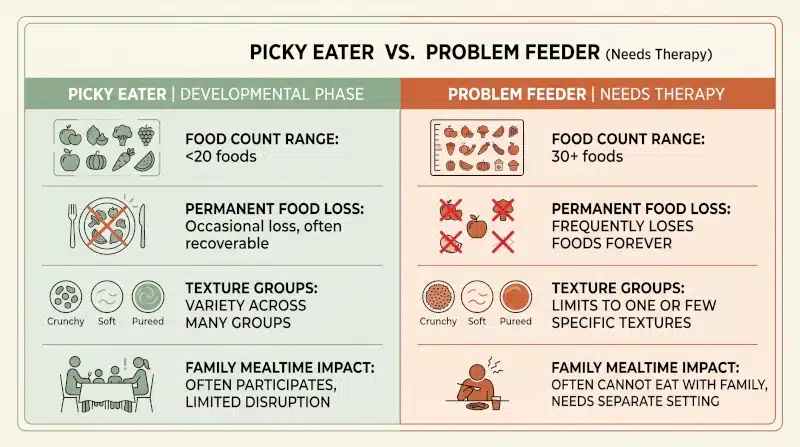
What Is the Difference Between a Picky Eater and a Problem Feeder?
Every young child experiences phases where they prefer carbohydrate-heavy foods, but there is a clear clinical boundary between a typical picky eater, a problem feeder, and Avoidant/Restrictive Food Intake Disorder (ARFID).
A typical picky eater might whine about eating broccoli, but they can tolerate having it sit on their plate while the rest of the family eats. They generally eat at least one food from every texture group and re-acquire dropped favorite foods after a few weeks.
A problem feeder, by contrast, experiences a full fight-or-flight nervous system response when exposed to unfamiliar or non-preferred foods. When extreme selectivity severely restricts caloric intake, leads to nutritional deficiencies, or causes deep psychosocial distress, it may align with clinical criteria for Avoidant/Restrictive Food Intake Disorder (ARFID).
Picky Eater vs. Problem Feeder Clinical Comparison
| Clinical Metric | Typical Picky Eater (Developmental Phase) | Problem Feeder / ARFID (Requires Feeding Therapy) |
| Accepted Food Range | Accepts 30 or more unique foods across textures | Eats fewer than 20 (and often fewer than 10) unique foods |
| Response to Food Burnout | Drops a favorite food during a phase, but re-acquires it weeks later | Drops a food permanently due to a “food jag” and never accepts it back |
| Texture & Food Group Flexibility | Accepts at least 1 to 2 foods from almost every food group or texture | Refuses entire food groups or specific textures (e.g., all wet, soft, or crunchy foods) |
| Mealtime Behavior & Emotions | May complain, but can remain seated at the family dinner table | Severe meltdowns, screaming, gagging, vomiting, or running away from the table |
| Oral-Motor Execution | Chews raw vegetables and meats with efficient rotary chewing | Struggles with tongue lateralization, pockets food, or tires out quickly |
| Social & Family Impact | Eats a slightly modified meal, but family can dine together out | Family cannot eat together; child requires separate, highly specific meals |
Over 500 Local Families Have Found Mealtime Peace Here Having guided over 500 families across La Cañada, Pasadena, and Greater Los Angeles through these exact mealtime challenges, we know how isolating this feels. You do not have to figure this out alone. Schedule a Free 15-Minute Feeding Consultation to talk directly with an Uplift specialist today.
Sensory Aversion vs. Oral-Motor Weakness vs. Medical Drivers: What Is Causing Your Child’s Mealtime Struggles?
When a child refuses food, we evaluate three primary underlying physiological drivers: sensory processing integration, oral-motor mechanics, and co-occurring medical factors.
1. Sensory Processing Integration & The 8 Sensory Systems
Sensory-based feeding difficulties happen when a child’s nervous system perceives specific textures, smells, temperatures, or visual appearances as overwhelming or dangerous. Eating is the only human activity that engages all 8 sensory systems simultaneously:
- Tactile (Touch): Feeling wet, sticky, or uneven textures on hands, lips, or tongue. A child with tactile hyper-reactivity may experience the texture of a wet peach or mashed potatoes the same way an adult might react to touching something unsafe.
- Olfactory (Smell): Processing ambient aroma. Smells travel directly to the brain’s limbic system, triggering instant nausea or anxiety if overwhelmed.
- Gustatory (Taste): Detecting sweet, salty, sour, bitter, and umami.
- Visual (Sight): Interpreting food color, shape, separation, and visual clutter on a plate.
- Auditory (Hearing): Hearing the crunch of a chip or the wet chew of meat inside the ear canal.
- Proprioception (Body Position): Gauging how hard to bite down on a cracker versus a banana without crushing it or tiring the jaw.
- Vestibular (Balance & Movement): Maintaining spatial orientation while seated upright at a table.
- Interoception (Internal Body Signals): Recognizing internal cues of hunger, fullness, thirst, nausea, or gastrointestinal pain.
When tactile or olfactory hyper-reactivity is present, a child’s protective gag reflex fires not out of stubbornness, but as an involuntary nervous system response designed to protect the airway.
2. Oral-Motor Mechanics & Chewing Endurance
Oral-motor feeding difficulties relate to the physical strength, coordination, range of motion, and muscle endurance required to chew and swallow safely.
Eating requires precise motor planning:
- Lip Closure: Holding food and liquids inside the mouth without drooling.
- Tongue Lateralization: The ability to move the tongue from side to side to push a food bolus onto the molars for chewing.
- Rotary Chewing: A mature, diagonal grinding jaw motion (rather than an immature up-and-down “munching” motion).
- Bolus Formation & Swallow Coordination: Gathering chewed food into a smooth ball and propelling it safely past the airway into the esophagus.
If a child has low muscle tone or poor tongue lateralization, chewing meat or raw vegetables becomes physically exhausting. They refuse those challenging textures simply because their jaw and tongue muscles tire out after two bites.
3. Co-Occurring Medical Factors & Reflux
We also rule out medical factors that create a physiological barrier to eating. Conditions like silent Gastroesophageal Reflux Disease (GERD), delayed stomach emptying, chronic constipation, Eosinophilic Esophagitis (EoE), or tongue-ties (ankyloglossia) cause eating to feel physically painful. Children quickly form a learned avoidance: “When I eat that food, my belly burns, so I will not put it in my body.”
Need Help Decoding Your Child’s Feeding Drivers? Whether your child experiences sensory overload, physical chewing fatigue, or hidden medical discomfort, our interdisciplinary team can pinpoint the exact root cause. Get Immediate Mealtime Relief for Your Child Today.
What Are the Top Red-Flag Signs That Warrant a Feeding Evaluation?
Dietary & Behavioral Indicators: The “Food Jag” Warning Sign
One of the most critical clinical indicators we observe in pediatric therapy is a pattern called food jagging.
A food jag occurs when a child will only eat a specific brand of food prepared in an exact, identical way (such as a specific brand of organic chicken nuggets cooked for precisely four minutes on a blue plate).
Over time, the child experiences sensory burnout from eating that same item daily. They suddenly refuse the food entirely, and unlike typical children, a problem feeder almost never re-acquires a dropped food.
As these food jags repeat over months, a child’s accepted food list shrinks from 30 items down to 15, 10, or even 5. This progressive loss of accepted foods is a clear signal that a child needs specialized feeding support.
Physical & Motor Red Flags: Gagging, Pocketing, and Coughing at the Table
Physical red flags point directly to underlying oral-motor or swallowing coordination challenges (pediatric dysphagia) that require immediate clinical evaluation:
- Frequent Gagging or Vomiting: While an anterior gag reflex is protective in young infants, persistent gagging when looking at, touching, or attempting to chew solid foods indicates sensory processing hyper-reactivity or oral-motor incoordination.
- Food Pocketing: Holding unchewed food in the cheeks or roof of the mouth for 20 to 30 minutes or more usually signals that a child lacks the tongue strength or motor planning to move food safely to their molars for chewing.
- Coughing, Watery Eyes, or Wet Vocal Quality: Coughing, throat clearing, or a “gurgly” wet voice during or immediately after swallowing liquids or solids can be a sign of micro-aspiration (food or liquid entering the airway). We follow strict ASHA clinical practice guidelines on swallowing safety whenever a coughing or breathing red flag is present.
- Inability to Transition to Table Foods: A child who continues to gag or choke on soft table foods past 12 months of age, or who relies exclusively on smooth purees, requires an oral-motor evaluation.
In my practice holding California Board-Approved Advanced Practice in Swallowing (SWC) credentials, I emphasize to parents that swallowing safety must always come first. When a child feels physically unsafe or unstable while swallowing, food refusal is actually their body’s smart way of protecting their airway.
What Actually Happens During a Play-Based Pediatric Feeding Therapy Session?
One of the biggest fears parents share before their first appointment is that therapy will involve forced eating, but modern pediatric feeding therapy is rooted in play, trust, autonomy, and nervous system co-regulation.
We never force a child to taste, chew, or swallow food. Forced compliance creates trauma, spikes cortisol, and increases mealtime anxiety.
Instead, we create a playful, sensory-friendly environment where children feel safe to explore foods at their own comfortable pace.
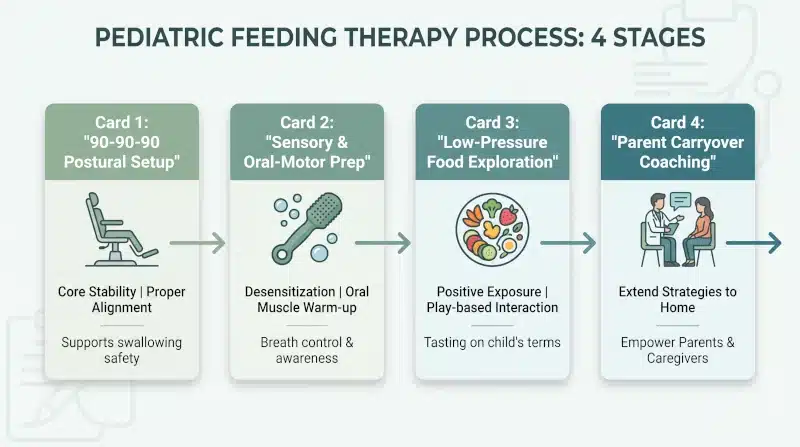
The 4-Stage Session Blueprint: From Postural Setup to Food Play
A typical 45-minute pediatric feeding therapy session at Uplift Therapy Center follows a structured, child-centered flow designed to organize the child’s body and mind:
- Postural Alignment & Biomechanical Support: We begin by ensuring the child’s body is physically supported. A child cannot use their fine oral-motor jaw and tongue muscles if their core is unstable. We establish a solid “90-90-90” seating position (hips, knees, and ankles supported at 90 degrees) with feet resting firmly on a footrest.
- Sensory Warm-Up & Body Preparation: Before food ever enters the room, we engage the child in regulating sensory activities. Guided by an Occupational Therapist, this may include deep-pressure body warm-ups, heavy work, swinging, or oral-sensory prep using textured chew tools to calm or wake up the nervous system.
- Low-Pressure, Play-Based Food Exploration: We introduce target foods through structured play. Food becomes a canvas for building towers, painting with dips, smelling, or zooming broccoli “trees” like cars, removing the expectation that the food must be eaten.
- Parent Coaching & Home Carryover: During the final 5 to 10 minutes, we review what worked during the session and provide parents with practical, stress-free strategies to try at home.
See How Play-Based Feeding Can Work for Your Child Our gentle, play-based model has helped hundreds of local children expand their diets without tears or battles. Claim Your Free Consultation with an Uplift Feeding Specialist.
How Do Therapists Introduce New Foods Without Meltdowns?
To help children expand their diets safely, we utilize evidence-based clinical frameworks including the Sequential Oral Sensory (SOS) Approach to Feeding, Food Chaining, and the Ellyn Satter Division of Responsibility.
1. The Sequential Oral Sensory (SOS) Approach to Feeding
Developed by Dr. Kay Toomey, the SOS Approach recognizes that eating is not a 1-step task, but a 32-step developmental hierarchy divided into 6 major categories:
- Tolerating: Being in the same room as the food, sitting at the table with the food present.
- Interacting With: Touching the food with a utensil, serving the food to someone else.
- Smelling: Leaning over to smell the food, leaning in close.
- Touch: Touching the food with fingertips, palms, cheeks, lips, and teeth.
- Taste: Licking the food, holding it on the tongue for 2 seconds and spitting it out into an “all-done bowl.”
- Eating: Chewing, swallowing, and fully consuming the food.
Celebrating a child for touching a piece of apple with a toothpick or licking a pretzel is a genuine clinical victory that builds internal confidence without triggering fight-or-flight panic.
2. Food Chaining Methodology
Food Chaining is another powerful tool where we use a child’s favorite food as a bridge to a similar new food by tweaking one sensory property at a time (flavor, texture, shape, or temperature).
For example, if a child in our La Cañada clinic will only eat a specific brand of fast-food French fry, we don’t immediately present a raw baby carrot. Instead, we map out a gentle food chain:
$$\text{Fast-Food French Fry} \longrightarrow \text{Grocery Frozen Fry (Same Shape)} \longrightarrow \text{Baked Potato Wedge} \longrightarrow \text{Roasted Sweet Potato Strip} \longrightarrow \text{Steamed Carrot Stick}$$
By making small, incremental tweaks, we build a bridge toward expanded nutrition without alarming the nervous system.
3. The Ellyn Satter Division of Responsibility (sDOR)
We also teach parents the Ellyn Satter Division of Responsibility in Feeding:
- The Parent’s Job: Decide WHAT food is offered, WHEN meals/snacks occur, and WHERE the family eats.
- The Child’s Job: Decide WHETHER to eat from the offered foods and HOW MUCH to consume.
Re-establishing these boundaries eliminates mealtime power struggles and restores peace to the dinner table.
Who Conducts Feeding Therapy? Understanding OT, SLP, PT, and Nutrition Roles
Because pediatric feeding spans sensory processing, chewing mechanics, postural alignment, and nutrition, an interdisciplinary team brings the most complete expertise to your child’s care.
| Discipline | Primary Feeding Focus & Clinical Scope | Key Interventions & Goals |
| Occupational Therapy (OT) | Sensory processing, tactile tolerance, fine-motor utensil use, emotional regulation, postural core stability | Calming nervous system hyper-reactivity, sensory warm-ups, self-feeding independence |
| Speech Therapy (SLP) | Oral-motor mechanics, tongue lateralization, jaw strength, chewing efficiency, swallowing safety | Building rotary chewing, bolus control, managing pediatric dysphagia |
| Physical Therapy (PT) | Gross motor core strength, pelvic alignment, head/neck control, trunk extension | Optimizing 90-90-90 seating stability and postural endurance during meals |
| Clinical Nutrition & Lactation | Caloric adequacy, micronutrient intake, infant latching, weight monitoring | Ensuring complete nutritional growth and preventing deficiencies during food chaining |
Why an Interdisciplinary Team Under One Roof Matters Most
At Uplift Therapy Center, our interdisciplinary team brings together OT, SLP, PT, Nutrition, and Lactation specialists in one unified clinic.
When an OT and SLP co-treat or collaborate directly on your child’s care plan, postural core stability, sensory comfort, oral-motor mechanics, and swallowing safety are addressed simultaneously. This integrated model significantly accelerates clinical progress compared to isolated therapy services.
How to Get Started with Pediatric Feeding Therapy in La Cañada Flintridge and Greater Los Angeles
Taking the first step toward specialized pediatric feeding guidance can bring immediate clarity, relief, and structure to your whole family.
What to Expect During Your Child’s Initial Feeding Evaluation
An initial feeding evaluation at our La Cañada Flintridge clinic is designed to feel warm, supportive, and non-judgmental. During the evaluation, we:
- Review Developmental & Medical History: We listen carefully to your family’s journey, medical history, GI concerns, and current mealtime routines.
- Assess Posture & Oral-Motor Function: We evaluate your child’s physical core alignment, jaw stability, lip seal, tongue movement, and chewing patterns in a playful setting.
- Conduct a Gentle Feeding Observation: We invite you to bring 2 to 3 preferred foods and 1 or 2 non-preferred foods to observe how your child interacts with food in real-time.
- Evaluate Sensory Processing: We assess how your child responds to textures, smells, visual presentations, and touch on their hands and mouth.
- Create a Personalized Care Plan: We map out clear, realistic goals tailored to your child’s nervous system and your family’s daily mealtime culture.
Located conveniently in La Cañada Flintridge, we proudly serve families across Pasadena, Glendale, San Marino, La Crescenta, South Pasadena, Burbank, and the San Gabriel Valley, as well as offering in-home pediatric services across Greater Los Angeles.
Your Exact Next Step: Let’s Transform Your Family’s Mealtimes You don’t have to carry mealtime battles alone for another day. Getting started is simple and stress-free:
- Click below to request your consultation.
- Speak with our clinical intake team to share your child’s specific struggles.
- Visit our clinic for a gentle, play-based feeding evaluation.
Claim Your Free 15-Minute Pediatric Feeding Consultation Today and give your child the tools to thrive at the dinner table.
Frequently Asked Questions About Pediatric Feeding Therapy
How do I find qualified pediatric feeding therapy near me?
When searching for specialized pediatric feeding therapy near me in La Cañada, Pasadena, Glendale, or Greater Los Angeles, look for an interdisciplinary clinic staffed by licensed occupational therapists and speech-language pathologists with specialized credentials in swallowing (SWC) and sensory frameworks like the SOS Approach to Feeding. A local clinic offering under-one-roof OT, Speech, PT, and Nutrition ensures all sensory, motor, and medical aspects of your child’s feeding are evaluated together.
At what age can a child start pediatric feeding therapy?
Feeding therapy can begin as early as infancy (0 to 12 months) for bottle feeding difficulties, nursing struggles, poor latch, or swallowing concerns, and continues through toddlerhood, early childhood, and adolescence for sensory food aversions, oral-motor weakness, or picky eating.
How long does pediatric feeding therapy typically take to see results?
Progress varies based on the underlying drivers (sensory hyper-reactivity, oral-motor weakness, or medical history). However, many families notice reduced mealtime distress, improved seating endurance, and increased comfort with new foods within 8 to 12 weeks of consistent weekly therapy and home carryover.
Will feeding therapy cover my child’s nutritional needs?
Feeding therapy focuses on expanding the variety, textures, and safety of food a child can comfortably chew and swallow. When needed, our feeding therapists collaborate directly with Registered Dietitians to monitor growth curves and ensure complete nutritional adequacy.
Do I need a doctor’s referral for a feeding evaluation in California?
While California law permits direct access to occupational therapy and speech-language pathology evaluation services, certain health insurance policies may require a physician’s referral or prescription for insurance reimbursement. Our intake team assists you in verifying your benefits.
What should I do if my child has a meltdown when new food touches their plate?
Avoid forcing, bribing, short-order cooking, or punishing your child during a meltdown. Calmly remove the immediate pressure, validate their sensory discomfort (“I see that feels tricky for your body right now”), provide a separate “all-done bowl” where they can place non-preferred foods, and focus on maintaining a safe, co-regulated mealtime environment.
Can feeding therapy help a child with Autism Spectrum Disorder (ASD) or neurodivergence?
Yes. Neurodiversity-affirming feeding therapy is highly effective for autistic and neurodivergent children who experience heightened sensory hyper-reactivity, texture sensitivities, oral-motor fatigue, or rigid mealtime routines. We honor each child’s bodily autonomy while building comfort at their pace.
How does swallowing safety (dysphagia) factor into feeding therapy?
If a child experiences coughing, choking, wet breathing, or frequent respiratory infections, a speech-language pathologist holding swallowing credentials (SWC) will evaluate the pharyngeal swallow phase to ensure food and liquid enter the esophagus safely without entering the airway.
What is the “90-90-90” seating rule and why does it matter?
The 90-90-90 rule refers to positioning a child so their hips, knees, and ankles are all bent at 90-degree angles with feet flat on a firm footrest. Proper foot support stabilizes the pelvis and spine, freeing up the jaw, tongue, and neck muscles for safe chewing and swallowing.
About Uplift Therapy Center & Dr. Talin Yacoubian
Founded by Dr. Talin Yacoubian, OTD, OTR/L, CAS, Uplift Therapy Center is a multidisciplinary pediatric therapy clinic in La Cañada Flintridge serving Pasadena, Glendale,Burbank, San Marino, and Greater Los Angeles. Dr. Talin brings over a decade of clinical pediatric expertise as a Doctor of Occupational Therapy, Certified Autism Specialist, and Advanced Practice Swallowing Specialist (SWC). Her practice is dedicated to delivering neurodiversity-affirming, play-based care that empowers children to build functional independence while walking alongside parents as trusted partners.
Learn more about Dr. Talin Yacoubian and the Uplift Pediatric Clinical Team.
Medical Disclaimer
The information provided in this article is for educational and informational purposes only and is not intended as medical, diagnostic, or professional healthcare advice. Every child’s developmental journey is unique. If you have concerns about your child’s growth, swallowing safety, or nutritional intake, please consult with a qualified pediatrician, licensed occupational therapist, or speech-language pathologist.
Immediate Pediatric Healthcare Directives & Crisis Support
If your child is experiencing acute swallowing distress, sudden weight loss, lethargy, or signs of airway compromise during feeding, please contact your primary pediatrician or visit your nearest emergency medical facility immediately.
- Emergency Medical Directives: Call 911 or visit your nearest Emergency Department for choking or acute airway compromise.
- 988 Suicide & Crisis Lifeline: Call or text 988 (24/7, free, confidential emotional support for caregivers in distress).
- Crisis Text Line: Text HOME to 741741 to connect with a crisis counselor.