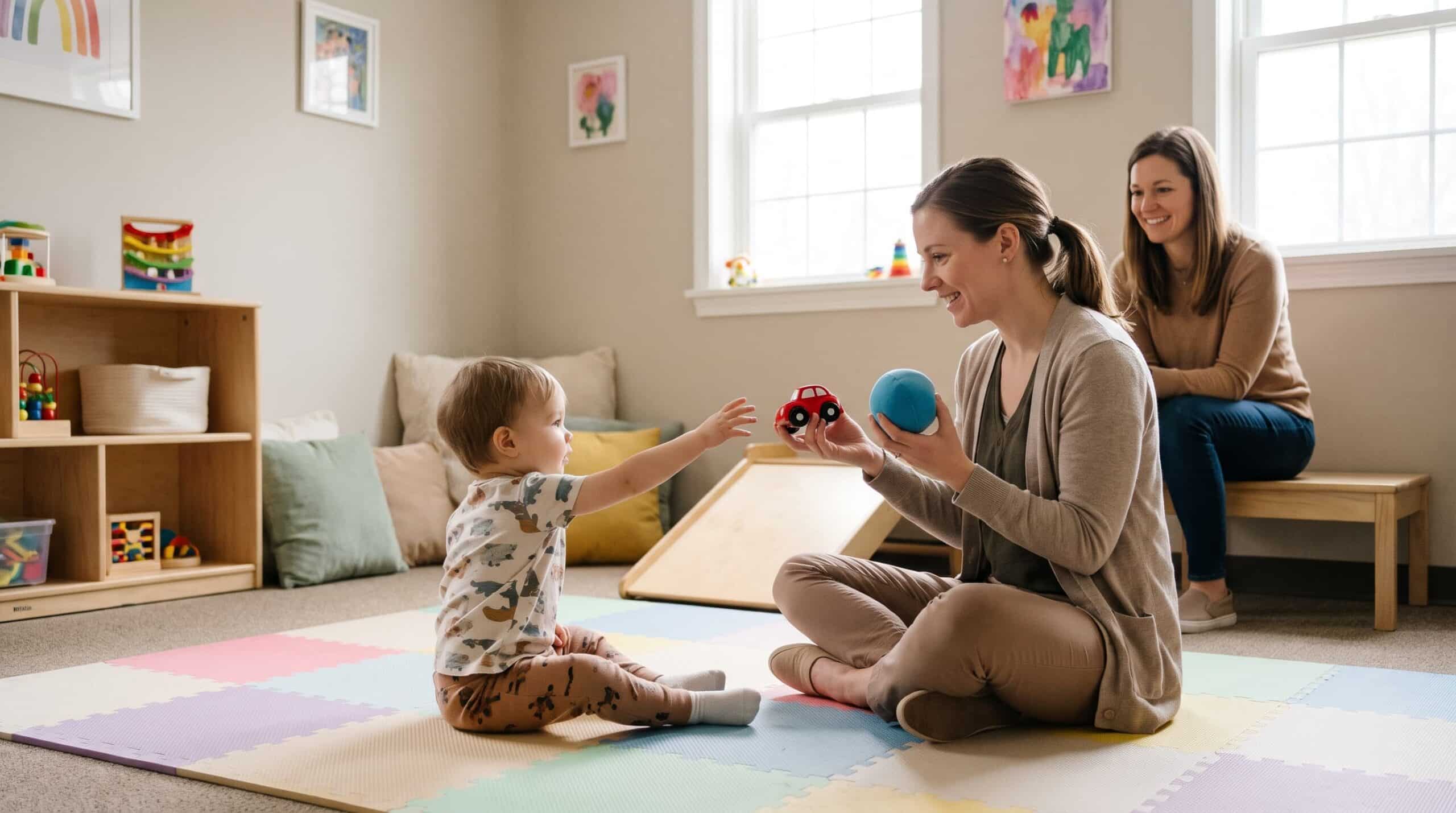
Across the kitchen counter, your toddler points, lets out a strained squeak, and tugs hard at your shirt. You know what they need: the blue cup. Meanwhile, at the playground, other two-year-olds are already stringing together lively phrases while your child relies on pointing, grunts, or silence.
Through years of pediatric therapy work in schools, family homes, and our clinic, and since founding Uplift Therapy Center in 2019, I have sat with many parents carrying this exact weight. Well-meaning relatives often tell you not to worry because “Einstein didn’t talk until four.” Still, that quiet parental instinct tells you something deserves a closer look.
Listening to that instinct is good parenting, not an overreaction. If you want an objective opinion, you can Schedule a Free Consultation to discuss your child’s development directly with our clinical team.
The Bottom Line: Key Takeaways for Parents
- Late talker vs. speech delay: A “late talker” understands language well and uses plenty of gestures despite a small spoken vocabulary, while a clinical delay affects comprehension, sound imitation, articulation, or social engagement.
- The risk of waiting: Research shows that 30% to 50% of late-talking toddlers do not catch up on their own by preschool, which raises the risk of later reading, behavioral, and school difficulties.
- Core developmental markers: Toddlers should imitate sounds and point with an index finger by 12 months, and use at least 50 spontaneous words combined into two-word phrases by 24 months.
- Speech sits atop other skills: Early talking connects directly to executive functioning, sensory processing, and emotional regulation.
- Evaluations without the hospital backlog: Comprehensive speech-language evaluations are available at our La Cañada Flintridge clinic, without the months-long waitlists common at large health systems.
Is My Child Just a “Late Talker” or Is It a Speech Delay?
Speech is the visible tip of an iceberg, supported underneath by comprehension, motor planning, and shared social connection.
Parents visiting our La Cañada Flintridge clinic often ask whether their toddler is simply on an independent timeline. To answer that accurately, we have to look beneath spoken words at the foundation supporting verbal communication.
A late talker is typically between 18 and 30 months old, uses fewer spoken words than expected, yet shows age-appropriate comprehension, expressive gestures, motor skills, and pretend play.
A speech-language delay, on the other hand, involves more than a lean vocabulary. Children with a delay often struggle to understand directions, imitate mouth shapes, use toys functionally, or share attention with caregivers.
The “Receptive-Expressive Disconnect”: How to Tell the Difference
Evaluating the gap between what a child understands (receptive language) and what they say (expressive language) offers the clearest diagnostic clue.
- Receptive Understanding: Can your toddler follow a basic request like “Find your shoes” without you pointing? When comprehension is intact, the brain’s language processor is doing its job.
- Functional Gestures: Does your child point with an index finger at an airplane overhead, wave goodbye spontaneously, or shake their head no? Regular gesture use is one of the strongest indicators that a late talker will catch up.
- Joint Attention: Does your child look at a toy, look up at your eyes to share a smile, and then look back at the toy? That back-and-forth gaze forms the bedrock of human interaction.
When receptive understanding and joint attention both lag behind, waiting rarely bridges the divide. If you see this disconnect, booking a pediatric speech and language evaluation helps pinpoint exactly where your child needs support.
| Clinical Dimension | The “Late Talker” Profile | Clinical Speech & Language Delay |
| Expressive Vocabulary | Uses fewer than 50 words at 24 months, with slow but steady gains | Minimal vocabulary paired with little babbling variety or vowel repetition |
| Receptive Comprehension | Understands complex phrases and multi-part directions with ease | Needs physical gestures, demonstrations, or hand-over-hand help to follow requests |
| Gesture Use (Pointing/Waving) | Communicates needs clearly through pointing, waving, and head nods | Points rarely; may pull an adult’s wrist like a tool without looking up |
| Sound Imitation | Copies animal sounds, car noises, and vowel variations willingly | Rarely imitates sounds, mouth movements, or physical actions during play |
| Social Play & Engagement | Enjoys interactive pretend play, such as feeding a toy dog or rolling cars | Prefers repetitive toy manipulation and avoids back-and-forth social games |
| Likelihood of Self-Correction | 50% to 70% catch up spontaneously in language-rich home environments | Low without direct speech therapy or targeted developmental intervention |
The Danger of “Wait-and-See”: Why Early Intervention Matters (The 30/50 Rule)
Well-meaning friends and doctors sometimes suggest waiting until age three to see what happens. In clinical practice, we urge families to be cautious with that advice.
Long-term studies demonstrate that between 30% and 50% of late talkers do not catch up without help. By the time these children enter preschool, unresolved language gaps often compound into struggles with early reading, working memory, and peer relationships.
Seeking help early is never about sticking a permanent label on your toddler. It simply capitalizes on early brain neuroplasticity, strengthening communication circuits when the nervous system is most adaptable.
If you find yourself questioning where your child stands, our team provides comprehensive developmental assessments that offer clear answers and a practical plan.
Speech and Language Milestones by Age: From 12 Months to 4 Years
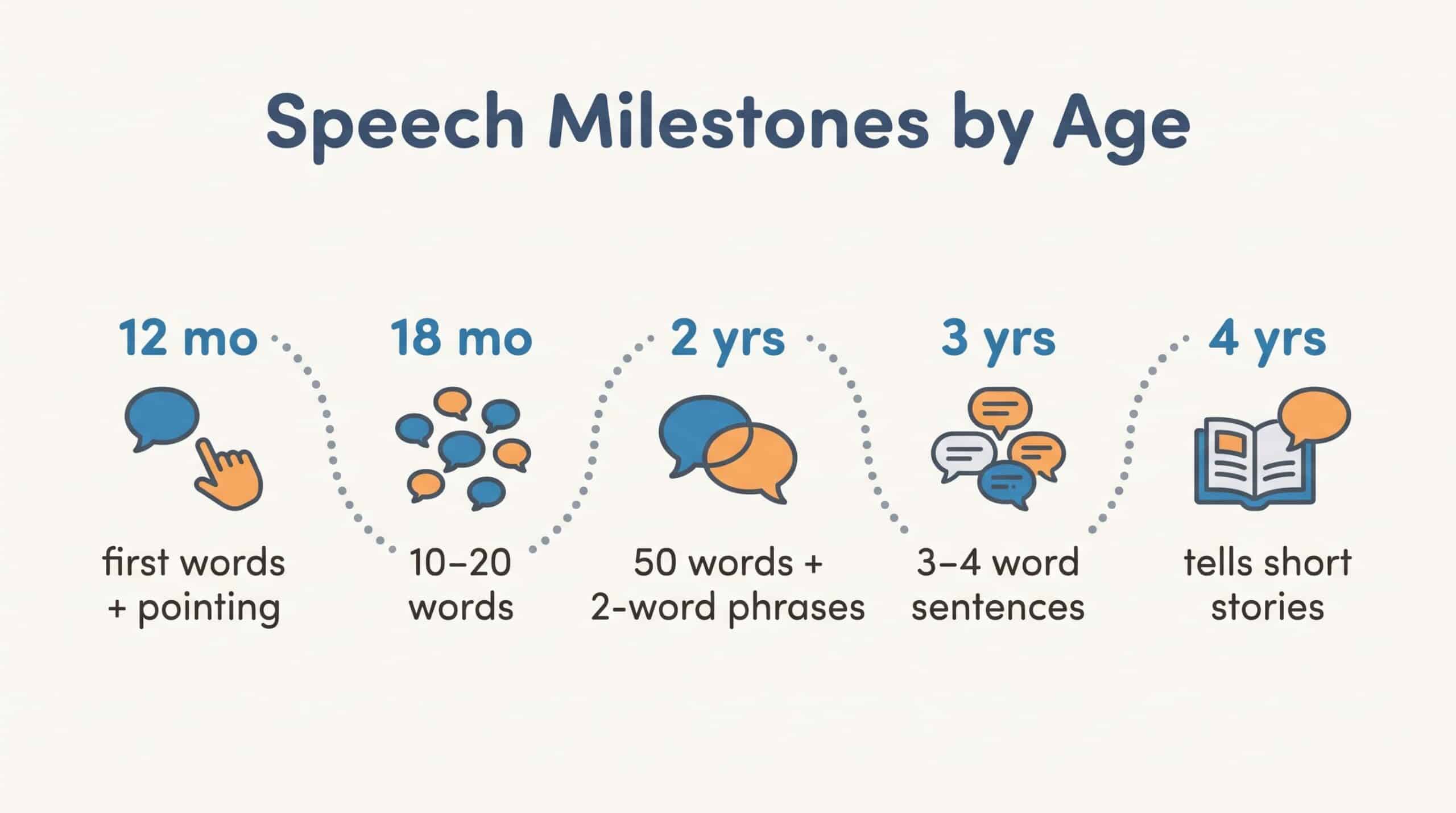
Communication follows a predictable developmental path, which means substantial delays call for objective assessment rather than passive waiting.
Every toddler develops at their own rate, but milestones mark clear developmental targets established through decades of research. Knowing these benchmarks helps parents tell whether a child is going through a brief plateau or experiencing a true delay.
The Pediatric Communication Timeline
- 12 Months – First Words & Purposeful Gestures: Turns toward own name and recognizes basic limits (“no”). Points, waves, and babbles with conversational pitch changes.
- 18 Months – The Vocabulary Spark: Speaks around 10 to 20 consistent single words on average (people, foods, actions). Identifies common body parts and points out pictures in books.
- 24 Months (2 Years) – The 50-Word & Two-Word Phrase Step: Speaks at least 50 distinct words across different settings. Spontaneously pairs 2 words together (“more juice,” “daddy out”). Primary caregivers understand at least half of spoken words.
- 36 Months (3 Years) – Short Sentences & Conversation: Talks in 3- to 4-word sentences and asks “what” or “where.” Follows two-step directions (“Grab the ball and drop it in the bin”). Familiar adults understand roughly 75% of speech.
- 48 Months (4 Years) – Storytelling & Detailed Grammar: Shares short stories using basic past tense, plurals, and pronouns. Unfamiliar listeners understand most of what they say.
12 to 18 Months: First Words and Functional Gestures
Between twelve and eighteen months, communication moves from random babbling to intentional words and gestures:
- Expressive Skills: Real first words start to show up, like “mama,” “dada,” or “cup.” Consistent approximations count as real words if your toddler uses them reliably for the same thing every time.
- Receptive Skills: Children should turn promptly when called by name, look toward familiar people when named, and pause when told “no.”
- Gestures: Pointing with an isolated index finger is the hallmark of this stage. A fifteen-month-old who never points to show you something interesting is missing an important milestone.
18 to 24 Months: Vocabulary Expansion and 2-Word Phrases
During this half-year window, vocabulary generally explodes.
- The 50-Word Benchmark: By age two, a child needs a working vocabulary of at least 50 spoken words. These should include diverse word types, like nouns (ball, dog), action verbs (run, eat), social words (bye-bye), and descriptors (cold, big).
- Two-Word Combinations: Toddlers must start putting two words together on their own, such as “more milk” or “truck go.” Simply reciting lines memorized from cartoons or songs does not count as spontaneous speech.
- Clarity: Parents and daily caregivers should understand about half of what the toddler says.
2 to 3 Years: Sentence Building and Speech Intelligibility
By three, talking becomes your toddler’s main tool for social play and self-regulation.
- Sentence Length: Children build from two-word fragments up to three- and four-word phrases (“I want red truck,” “Mommy make dinner”).
- Understanding Directions: Toddlers can handle two unrelated steps (“Drop the crayon and sit on the rug”) without needing visual demonstrations.
- Clarity: Close family members should understand about 75% of what the child says, while unfamiliar listeners should catch roughly half.
3 to 4 Years: Complex Language and Social Conversation
At four, speech is no longer just about practical needs; it becomes a tool for making friends, telling stories, and asking questions.
- Daily Conversation: Four-year-olds ask lots of questions (“Why?”, “Where are we going?”), talk about what happened earlier in the day, and use pronouns (he, she, they) along with past-tense verbs.
- Clarity: Most of what a four-year-old says should be understood, even by strangers, preschool teachers, and other kids. The traditional rule of thumb puts this at 90% to 100% intelligible, though newer research finds the typical four-year-old closer to 75% to 80%. Frequent sound dropping, obvious stuttering, or garbled words at age four warrants an evaluation.
Red Flags Checklist: Signs Your Child Needs a Professional Speech Evaluation
Spotting multiple communication warning signs early protects children from unnecessary academic and social frustration later on.
Parents often wonder where the line sits between a minor developmental quirk and a clinical delay. If you recognize several of these warning signs, consider scheduling an assessment:
- By 12 Months:
- No babbling with varied consonants (“ba-ba,” “da-da”).
- No steady response when called by name.
- No social gestures like waving, reaching up to be held, or shaking their head.
- By 15 to 18 Months:
- Zero recognizable single words spoken spontaneously.
- No pointing with an index finger to show you an object or share excitement.
- Blank reaction when you point at something across the room.
- Crying or screaming as the only method to communicate basic wants.
- By 24 Months (2 Years):
- Fewer than 50 spoken words used across everyday routines.
- No spontaneous two-word combinations formed without adult prompts.
- Significant difficulty copying new words, sounds, or actions.
- Inability to follow simple routine requests (“Grab your coat”) without physical guidance.
- By 36 Months (3 Years):
- Speech remains mostly unintelligible to family members and strangers alike.
- Inability to speak in simple three-word sentences.
- Ongoing trouble making eye contact, joining peer play, or enjoying shared games.
- Repeating questions back verbatim rather than answering them directly (echolalia).
- At Any Age:
- Any sudden loss of previously mastered words, babbling, or social gestures.
- Frequent, explosive meltdowns driven by communication frustration.
- Visible physical strain, jaw clenching, or facial tension while trying to talk.
Behavioral and Sensory Clues Behind Speech Hesitation
When toddlers cannot speak, frustration builds quickly. A child without words cannot explain that the room feels too loud, their shoes feel tight, or they wanted water instead of milk.
As a result, unaddressed speech delays often surface as biting, hitting, head-banging, or frequent tantrums. In our clinic, addressing communication barriers often reduces these difficult behaviors at home.
Seeing two or more of these red flags simply means your family deserves extra support. You can Schedule a Free Consultation with our team to talk through what you are seeing at home.
4 Evidence-Based Speech Therapy Exercises to Do at Home (With Parent Scripts)
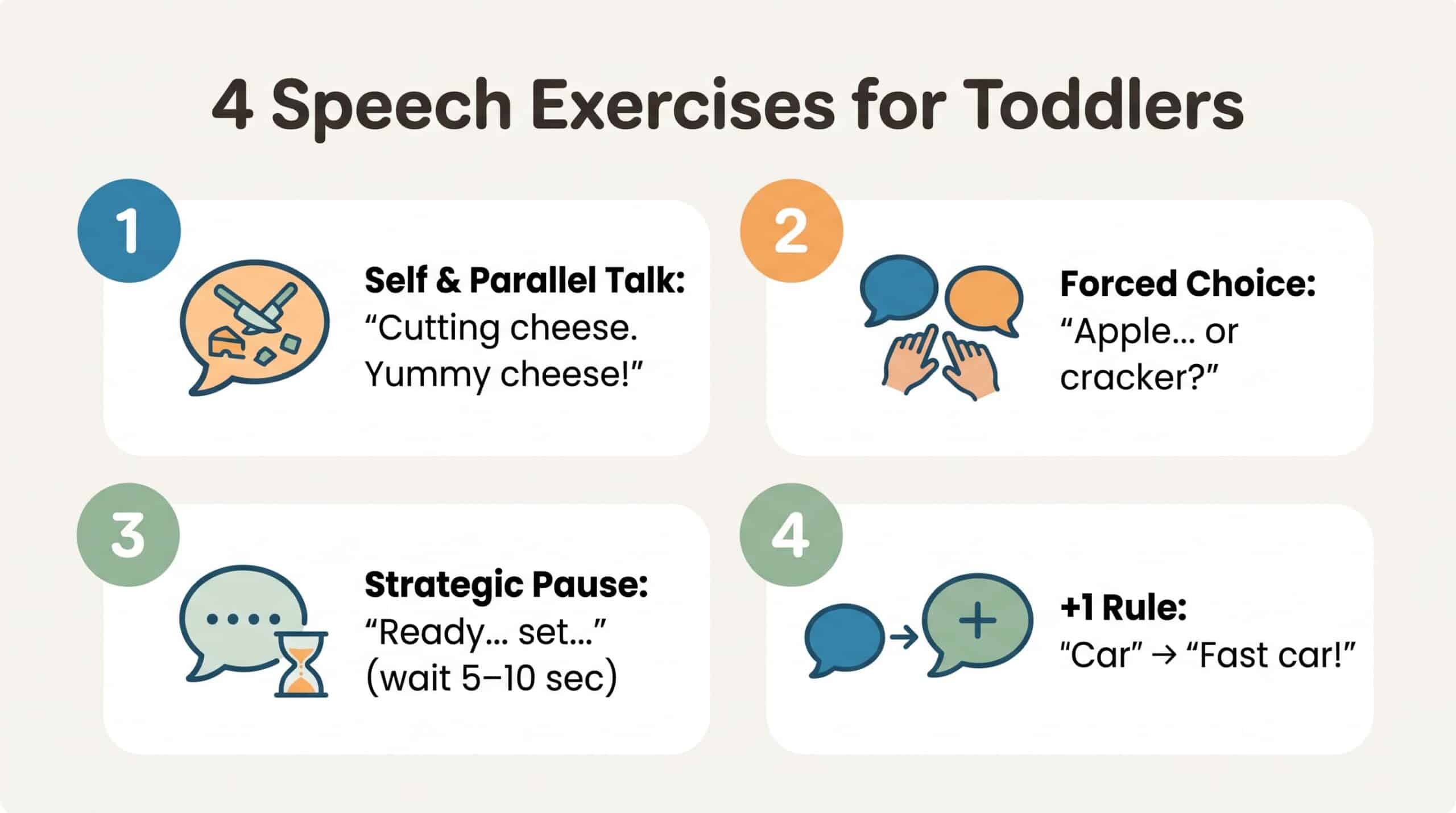
Everyday household routines offer the most natural setting for speech exercises, requiring no flashcards or tablet apps.
Language develops through ordinary moments, such as putting away groceries, bath time, cooking, and floor play.
Here are four practical techniques used by pediatric speech therapists that you can start using right away. If home strategies alone aren’t closing the gap, our speech therapy services can provide more structured, one-on-one support.
The Routine-Embedded Communication Model
- Self-Talk & Parallel Talk – Describe actions out loud without grilling your child with questions.
- Forced Choice Modeling – Offer two visible options to move past yes/no dead ends.
- Strategic Pause & Time-Delay – Wait 5 to 10 seconds instead of immediately anticipating every want.
- Play-Based Expansion (The +1 Rule) – Take whatever single word your child says and hand it back with one more.
Exercise 1: Self-Talk and Parallel Talk (Routine Embedding)
It is tempting to quiz toddlers constantly: “What color is this? Can you say car? Say apple!”
Quizzing creates performance pressure, which frequently causes a hesitant speaker to clam up. Instead, lean on Self-Talk (narrating your own actions) and Parallel Talk (narrating your child’s actions) like an easygoing radio commentator.
- How to Do It: Use clear 2- to 3-word sentences with melodic emphasis on the main words.
- The Script (During Lunch):
- Skip this: “What are you eating? Say cheese!”
- Try this (Parallel Talk): “Cutting cheese. Yummy cheese! Big bite for you!”
- Try this (Self-Talk): “Pouring milk. Cold milk. Splash into the cup!”
Exercise 2: Forced Choice Modeling (Reducing Frustration)
When a toddler points or grunts near the kitchen counter, parents often guess immediately and hand over a snack to prevent a meltdown. That solves the moment, but it skips valuable practice.
Forced Choice Modeling offers an easy communication step while modeling the exact sounds your child needs to hear.
- How to Do It: Hold two options up near your eyes so your toddler looks between the snacks and your lips.
- The Script (During Snack Time):
- Hold a cracker in one hand and an apple slice in the other.
- Say this: “Do you want apple [lift apple]… or cracker [lift cracker]?”
- If they point to the cracker without speaking, validate the gesture by labeling it: “Cracker! You picked the cracker. Let’s open it!”
Exercise 3: Strategic Pause and Time-Delay (Building Communication Urgency)
Because loving parents read their toddlers so well, we often hand them items before they even ask. If children never have a reason to ask, their brains have less incentive to coordinate speech muscles.
- How to Do It: Set up an anticipated activity, such as blowing bubbles or pushing a swing. Begin the fun, pause right at the peak moment, and wait quietly for 5 to 10 full seconds while holding warm, expectant eye contact.
- The Script (Blowing Bubbles):
- Dip the wand, hold it near your mouth, and say: “Ready… set…”
- Stop moving. Hold still. Wait 7 seconds quietly.
- Watch closely. If your toddler looks at you, makes a sound, or says “Go,” smile big and blow the bubbles: “GO! Big bubbles everywhere!”
Exercise 4: Play-Based Imitation and Expansion (The +1 Rule)
Speech grows one small step at a time. When a child speaks in single words, responding with full paragraphs can overwhelm them. Stick to the +1 Rule: take whatever word your toddler uses, and repeat it back with one additional word.
- How to Do It: Sit on the floor at eye level. Copy their physical actions first, then expand their spoken words.
- The Script (Playing with Toy Cars):
- Toddler rolls a car: “Car.”
- Parent expands (+1): “Fast car! Vroom, fast car!”
- Toddler spots a dog outside: “Dog.”
- Parent expands (+1): “Big dog! That dog is barking!”
Need a Milestone Tracker at Home?
You do not have to guess your way through your toddler’s speech milestones. Download our free Toddler Speech & Milestone Screening Checklist to track their progress at your own pace.
What Happens During a Professional Speech & Developmental Evaluation?
A developmental evaluation is a play-based assessment that clarifies your child’s complete communication profile.
Many parents imagine a clinical evaluation involving a toddler sitting at a sterile desk under harsh office lights.
At Uplift Therapy Center, evaluations are built entirely around playful, engaging activities that help your child feel comfortable and safe.
The 4-Step Comprehensive Evaluation Pathway
- Developmental Intake & Parent Interview – Review pregnancy, early health history, routines, and specific worries.
- Direct Standardized Clinical Observation – Interactive play activities evaluating expressive and receptive skills.
- Multi-Clinician Collaborative Review – Our licensed speech-language pathologists review results to rule out CAS and flag signs of ASD or ADHD for referral.
- Plain-Language Feedback & Actionable Roadmap — Clear results and practical support plans you can put to work at home.
During the appointment, our speech-language pathologists combine standardized assessments with observational play to examine four main areas:
- Expressive Language: The range, complexity, and clarity of sounds, words, and sentences your child produces.
- Receptive Language: How well your toddler understands verbal requests, concepts, and names of common items.
- Motor Speech Planning: Oral-motor coordination and muscle movements, ruling out structural issues or Childhood Apraxia of Speech (CAS).
- Social-Emotional & Cognitive Functioning: Determining whether speech hesitation stands alone or connects with Autism Spectrum Disorder (ASD), sensory differences, or broader cognitive patterns.
Avoiding Months-Long Hospital Waitlists
Families around La Cañada Flintridge, Pasadena, and Glendale often discover that hospital clinics and large health systems have waitlists that can stretch for months.
For an eighteen-month-old toddler, waiting a year means spending a third of their early life without targeted support. Crucial developmental windows slip away while parents wait on administrative lists.
At Uplift Therapy Center, we believe families deserve timely guidance backed by seasoned clinical insight.
- Multidisciplinary Team Under One Roof: Speech, occupational, physical, and feeding therapists work side by side, so your child’s needs can be looked at from every angle.
- Clear, Actionable Roadmaps: You get a plain-English report detailing speech targets, at-home routines, and school support recommendations (IEP/504).
- In-Clinic Care: We see children in person at our La Cañada Flintridge clinic at 1975 Verdugo Blvd., Suite D.
Frequently Asked Questions About Toddler Speech Delays
How do I know if my child needs speech therapy or is just being stubborn?
Toddlers are rarely “too stubborn” to speak. When a toddler understands words but cannot produce them, they are almost always dealing with motor speech hurdles, difficulty putting words together, or anxiety. Calling it defiance misses the real physical or neurological obstacle. An evaluation identifies the root cause and takes the pressure off everyone.
Can a toddler catch up from a severe speech delay on their own?
Some late bloomers catch up, but between 30% and 50% do not. Children who struggle with comprehension as well as speech, or who use few communicative gestures, rarely catch up without targeted support. Waiting on self-correction often creates preventable difficulties with early reading and school confidence.
What is the difference between a speech delay and autism?
An isolated speech delay affects communication mechanics, but the child still points, smiles, makes eye contact, and plays back-and-forth games. In Autism Spectrum Disorder (ASD), communication differences appear alongside social reciprocity changes, repetitive behaviors, and sensory sensitivities. A comprehensive speech-language evaluation, with referral for a diagnostic autism assessment when needed, carefully distinguishes between the two.
Does insurance cover private pediatric speech and developmental evaluations?
Many commercial plans provide out-of-network reimbursement for developmental and speech assessments. Uplift Therapy Center is in-network with Kaiser and operates out-of-network with most other insurers, but we give you complete, coded superbills that you can submit directly to your insurer for potential reimbursement.
Taking the Next Step: Fast-Track Your Child’s Growth and Peace of Mind
Catching communication delays early gives children the tools they need for lifelong confidence and clear self-expression.
You do not have to spend months wondering, second-guessing yourself, or sitting on indefinite waitlists. Your child’s communication shapes their relationships, confidence, and daily happiness.
At Uplift Therapy Center, our team pairs deep clinical rigor with genuine warmth and prompt scheduling. We help families skip the hospital backlogs so you can move forward with a clear plan.
Getting started is straightforward:
- Schedule a Free Consultation: Book a free consultation through our online scheduling portal.
- Complete the Assessment: Meet our pediatric clinicians in La Cañada Flintridge for a relaxed, play-based session.
- Get Your Plan: Walk through your results and receive a complete clinical report, ready to share with doctors and preschool teachers.
Ready for Clear Direction?
Your child deserves support, and your family deserves real clarity. Schedule a Free Consultation with Uplift Therapy Center today, or call our office directly at 818-864-6602. We are here to help.
About the Author & Practice
Dr. Talin Yacoubian, OTD, OTR/L, CAS, is the founder of Uplift Therapy Center, a pediatric therapy clinic at 1975 Verdugo Blvd., Suite D, in La Cañada Flintridge, California. She earned her bachelor’s, master’s, and doctoral degrees in occupational therapy from the University of Southern California and is a Certified Autism Specialist, with experience across school-based, in-home, and in-clinic pediatric settings. Dr. Talin founded Uplift in 2019 as an in-home practice and opened the La Cañada clinic in July 2022, where speech-language pathologists, occupational therapists, physical therapists, and feeding therapists now work side by side.
This article was clinically reviewed by Ashley Sohrab, MS, CCC-SLP, Uplift’s Lead Speech Therapist, who has worked as a speech-language pathologist for ten years and holds a Master of Science in Communication Sciences and Disorders from Chapman University
Meet Dr. Talin and our pediatric speech-language pathologists on our team page.
Medical & Clinical Disclaimer
The information in this article is provided for educational and screening purposes only and does not constitute formal medical or psychological advice. Reading this guide does not establish a doctor-patient relationship. Every child’s development is unique, and developmental concerns should always be assessed in person by a qualified healthcare provider, speech-language pathologist, or licensed clinical psychologist.
Developmental & Crisis Support Resources
- CDC Milestone Tracker: Access developmental tracking tools at cdc.gov/act-early.
- California Early Start: Connect with local infant and toddler early intervention services through the Early Start BabyLine at 1-800-515-2229.
- 988 Suicide & Crisis Lifeline: Call or text 988 for free, round-the-clock emotional support.
- Emergency Services: Call 911 or visit your local emergency room if your child faces an acute medical emergency.