By Dr. Talin Yacoubian, OTD, OTR/L, CAS | Clinical Review Date: July 16, 2026
When you first start looking into pediatric developmental support, it is natural to feel overwhelmed. As a parent, you are your child’s first and most fierce advocate. If a pediatrician, a teacher, or your own gut has pointed you toward pediatric occupational therapy (OT), you likely have a run of questions. Is my child going to be tested? Will they feel stressed? What actually goes on behind those clinic doors?
I want to reassure you right now: we aren’t here to put your child under a microscope. In my years of clinical practice, I have found that the most valuable clinical insights do not come from rigid, sterile testing rooms. They happen when a child is engaged, feels safe, and leads the way.
At Uplift Therapy Center, we believe that parent partnership is the absolute foundation of therapy. Let’s walk through exactly what you and your child will experience during your very first visit to our sensory space.
What is a Pediatric OT Evaluation?
If you are looking for a quick, factual overview of what to expect, here is a direct summary of our evaluation process:
A pediatric occupational therapy evaluation at Uplift Therapy Center (serving Pasadena,La Canada, CA) is a 60-to-90-minute evaluation that combines structured play-based activities with standardized clinical assessments. Our licensed therapists assess your child’s sensory processing, fine and gross motor skills, and developmental milestones. Standardized tests help establish objective baselines, compare your child’s abilities to peer norms, and measure functional progress over time. These consistent metrics support evidence-based care and help determine the appropriate frequency of services.
At a Glance: Key Takeaways for Parents
- Standardized & Play-Based Assessment: Evaluations combine child-led, structured activities in our specialized sensory gym with standardized tests that provide objective measurements of your child’s abilities and progress.
- No Referral Needed: California direct access laws permit direct evaluations without a medical referral, though some insurance companies may require pediatric pre-authorization.
- Clear Next Steps: Following the 60-to-90-minute evaluation, we discuss the treatment plan, establish goals tailored to your child’s needs and your family’s routine, and determine the appropriate frequency of services.
What Happens During a Pediatric OT Evaluation? (The 3-Step Process)
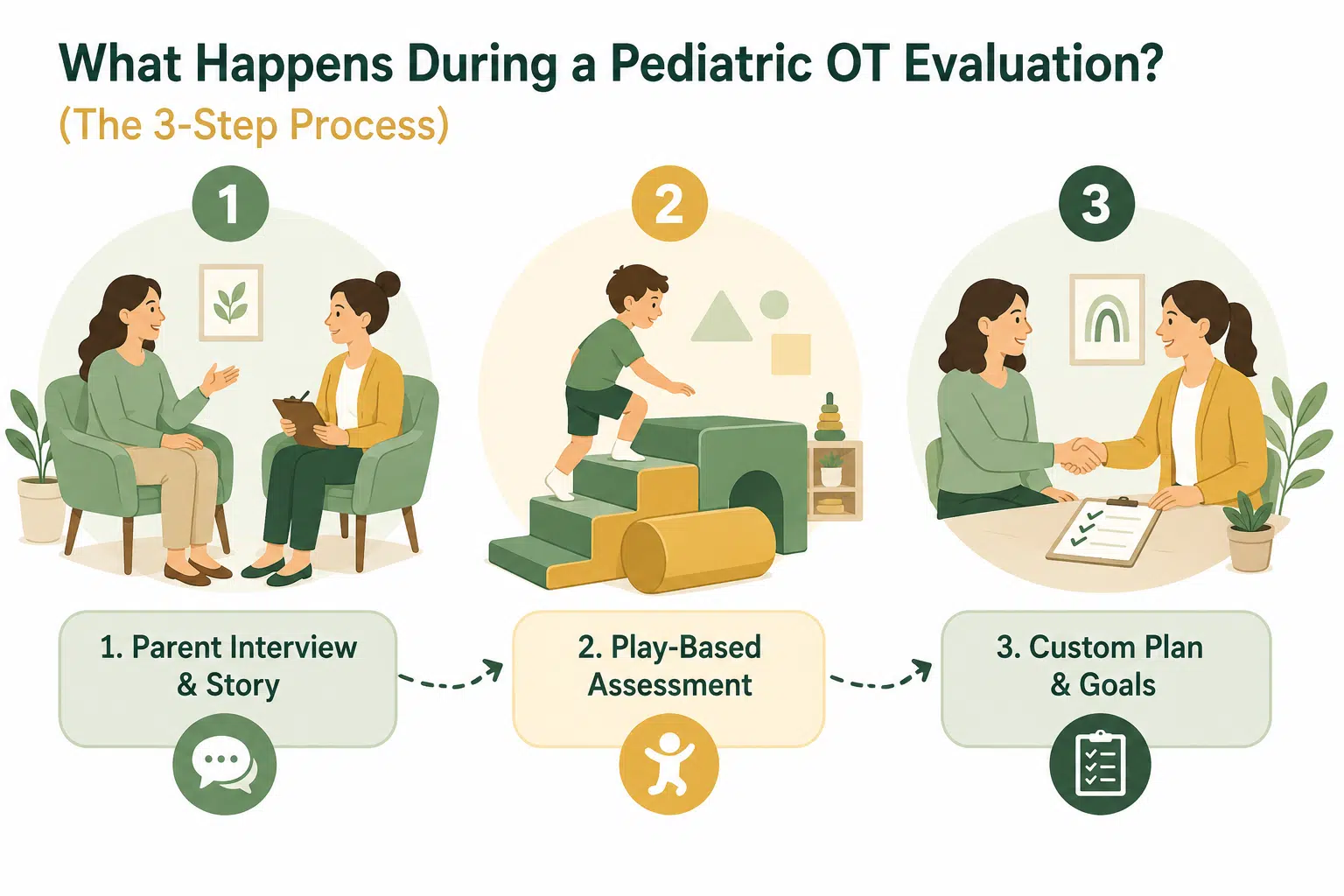
To make your experience as simple as possible, we break our evaluation down into three family-centered steps. This structure ensures we capture a true, authentic picture of your child’s unique strengths and developmental profile.
Step 1: The Parent Interview & Developmental History
Before we focus on physical play, we focus on your family’s story. I often tell parents that you are the true expert on your child. We will sit down together,in a private and comfortable corner of our clinic, to discuss your child’s birth history, early milestones, daily routines, and school experiences.
Before your visit, we also send intake paperwork for you to complete. This asks about your child’s developmental history, daily routines, school experiences, and other information that helps us understand your child’s needs. During the evaluation, we review this information together, clarify details, and ask follow-up questions as needed.
We talk about what makes your child light up, where they excel, and exactly what daily activities are causing friction. Whether it is a struggle with getting dressed in the morning, high sensitivity to loud noises at a local Pasadena park, or difficulty holding a pencil at preschool, this conversation shapes our entire clinical focus.
Step 2: Clinical Play-Based Observation
This is where we typically move into our sensory gym. To your child, this step feels like visiting an indoor playground. To our clinical eye, however, every jump, climb, and reach is a critical piece of developmental data.
Through our expert matching process, we pair your child with a therapist whose specialty and clinical expertise align with your child’s specific needs. We consider the therapist’s experience and areas of expertise to help ensure your child receives care from a clinician who is well suited to address their developmental and therapeutic needs.
Step 3: Standardized Assessments & Collaborative Goal Setting
To round out our clinical observations, we may utilize age-appropriate, standardized developmental tasks. These might look like puzzles, bead-stringing games, or scissor activities. These tasks allow us to measure your child’s fine motor coordination, bilateral integration, visual-spatial skills, and executive functioning against age-matched developmental baselines.
Once the play is complete, we do not simply hand you a clinical report filled with medical jargon. We sit down as partners to write meaningful, functional goals. We focus on goals that will help your child excel in everyday life, whether that means successfully tying their shoes, staying calm in busy classroom environments, or confidently playing with peers.
The Sensory Gym: Where Play Becomes a Diagnostic Tool
Many traditional clinics evaluate children in small, desk-bound rooms. In my clinical experience, these quiet, sterile environments often trigger sensory defensiveness or anxiety, hiding a child’s true capabilities.
Our La Cañada Flintridge clinic, located just minutes from Pasadena, was intentionally designed to be a sensory-rich haven. Our sensory gym features specialized swings, climbing walls, ball pits, and tactile pathways. We utilize this space as an active evaluation tool because children show their most organic motor planning, balance, and sensory behaviors when they are moving naturally.
To help you understand how we translate play into clinical science, here is a breakdown of what you might see your child doing, and what our clinical team is actually analyzing:
| What Your Child Sees (The Play) | What the Therapist is Observing (The Clinical Science) |
| Climbing up a vertical rope ladder | Bilateral coordination, core strength, and motor planning. We observe how both sides of the body work together and how your child plans their motor movements in sequence. |
| Swinging on a platform swing | Vestibular processing and postural control. We evaluate how your child’s nervous system processes movement, balance, and gravity, which directly impacts their ability to sit upright in a classroom chair. |
| Playing in a specialized ball pit | Tactile processing and proprioceptive input. We observe if your child seeks deep pressure to calm their nervous system, or if they show signs of sensory defensiveness to different textures. |
| Using tweezers to rescue small toys from putty | Fine motor precision and hand strength. We analyze their hand muscle development, pincer grasp, and visual-motor integration (essential prerequisites for writing and utensil use). |
Meet the Team: We invite you to meet our multidisciplinary team of pediatric therapists to explore our credentials, clinical specializations, and play-based backgrounds.
Specific “Tests” You Might See (And Why We Do Them)
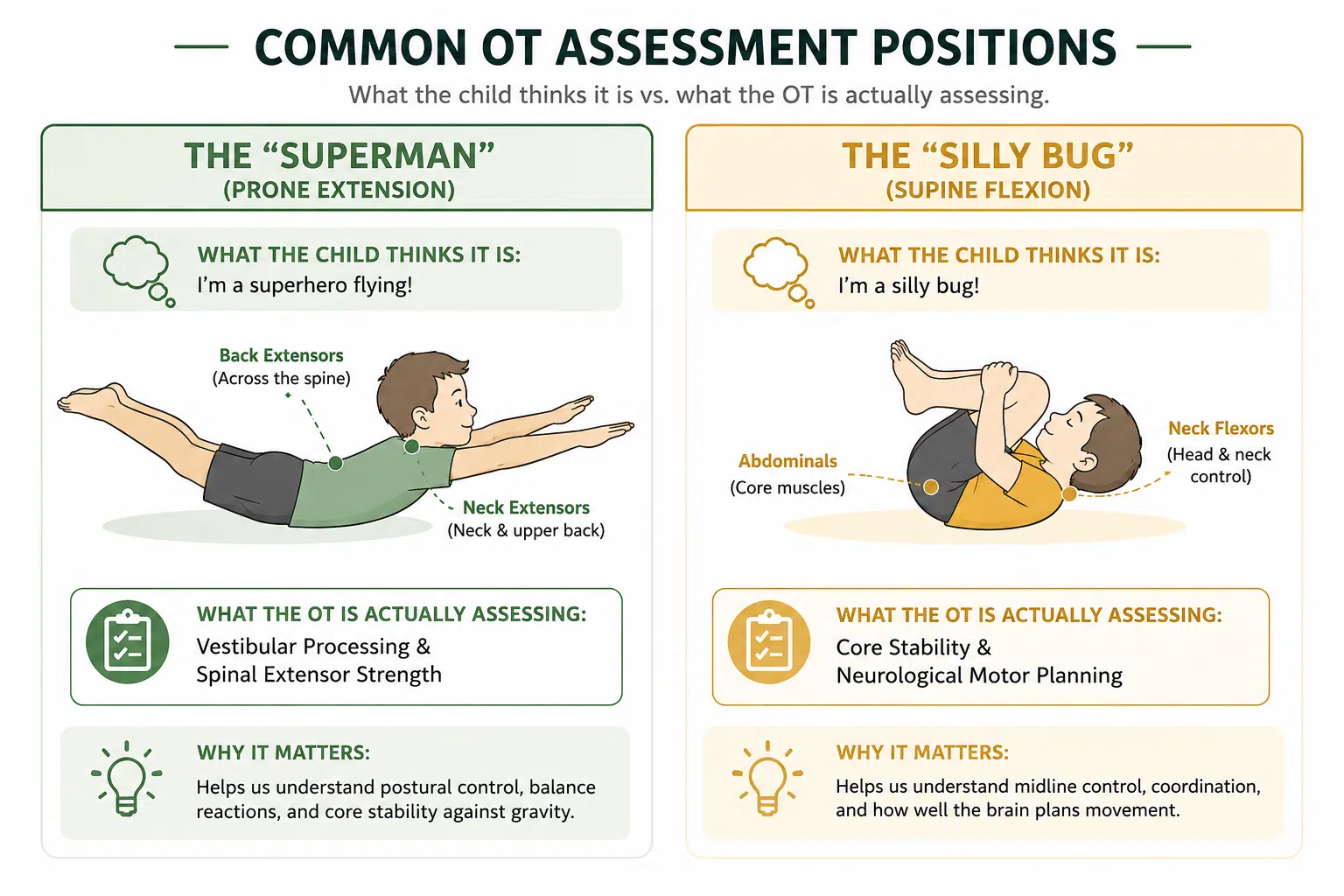
During the gross motor and sensory portion of our evaluation, your therapist might guide your child into some specific, playful postures. These gravity-defying positions look like silly gym games, but they are highly diagnostic clinical markers of neurological and physical development.
The “Superman” Position (Prone Extension)
In this posture, your child lies on their tummy and lifts their head, chest, arms, and legs off the floor simultaneously, holding them straight out like a superhero flying through the air.
- What we are measuring: We assess your child’s extensor muscle strength and how their vestibular system responds to gravity.
- Why it matters: A child who struggles to hold this position for more than a few seconds often lacks the foundational core strength required to sit upright at a school desk without slouching, leaning, or experiencing physical fatigue.
The “Silly Bug” Position (Supine Flexion)
Here, your child lies on their back, curls into a ball, brings their knees to their chest, and lifts their head and arms to hug their knees, holding the position without rolling or letting their feet drop.
- What we are measuring: We evaluate flexor muscle strength, motor planning, and bilateral integration.
- Why it matters: This position challenges the deep core muscles and shows us how well your child’s brain and muscles communicate to maintain physical stability. Deep core stability is directly linked to fine motor control. A stable trunk allows for precise, coordinated movements of the hands and fingers.
How to Prepare Your Child (and Yourself) for the First Visit
Preparation is the best antidote to anxiety, for both you and your child. Here are a few practical, low-stress strategies to ensure a smooth, positive transition into our clinic.
- Keep It Simple and Fun: Avoid using words like “testing,” “doctor,” or “evaluation.” These terms can trigger performance anxiety. Instead, try a parent-friendly script: “We are going to visit Uplift’s sensory playground today. We get to meet a new friend who wants to play, climb, and swing with you to see how strong your muscles are!”
- Dress for Movement: Ensure your child wears comfortable, flexible, sensory-friendly clothing. Loose-fitting t-shirts, leggings, or sweatpants without complex buttons or tags are ideal. To help keep our sensory gym clean and safe for everyone, please remove your shoes before entering. Grip socks are required, and if you don’t have a pair, they’re available for purchase at the front desk.
- Gather Your Developmental Documents: If your child has an Individualized Education Program (IEP), a 504 plan, private speech therapy progress reports, or recent pediatric evaluations, please bring them along. These documents help us build a highly cohesive, coordinated care model.
- A Note on Siblings: If possible, we recommend arranging childcare for siblings, especially for this first visit. This allows you to fully engage in the parent interview and gives your child our undivided clinical attention in the sensory gym.
As a California parent, handling the administrative and financial side of pediatric healthcare can sometimes feel overwhelming. We are committed to making this process as transparent and friction-free as possible.
Do I need a doctor’s referral for pediatric OT in California?
Under California law, pediatric occupational therapists can provide therapy services without a referral. However, many private health insurance plans still require a written prescription or referral from your pediatrician to authorize coverage and reimbursement.
At Uplift Therapy Center, we handle the heavy lifting for you. Our administrative team works directly with your family and your pediatrician’s office to coordinate authorizations, help clarify your insurance benefits. We are currently in-network with Kaiser, while coverage and authorization requirements may vary for other insurance plans.
Frequently Asked Questions About Pediatric OT Evaluations
How long does a pediatric OT evaluation take?
A standard evaluation takes between 60 to 90 minutes. This comprehensive timeframe allows us to transition at your child’s pace, ensuring they do not feel rushed or overwhelmed as we move between the parent interview, sensory gym play, and fine motor games.
Do I stay in the room with my child during the evaluation?
Yes, absolutely. We strongly encourage parents to remain in the room, especially for early intervention and younger children. Your presence provides a critical “secure base” for your child, allowing them to explore our sensory gym confidently. It also gives us an opportunity to point out real-time observations and partner with you on strategies you can replicate at home.
What happens after the evaluation is finished?
Following the evaluation, your therapist will compile all clinical observations, standardized testing data, and parent goals into an Evaluation Report. We will schedule a follow-up consultation to walk you through this report step-by-step, discuss our recommended frequency of care, and hand you a personalized, practical roadmap to support your child’s development in their everyday life.
If you’d like to skip straight to that first step, you can schedule your child’s evaluation with our team whenever you’re ready.
Let’s Take the First Step
Watching your child struggle with daily tasks is incredibly stressful, but you do not have to figure this out on your own. Let’s work together to help your child find their footing and reach their milestones at a pace that feels right to them.
Schedule a Free Consultation Today: Ready to take the first step? We invite you to book a free, HIPAA-compliant developmental consultation with our team to explore tailored pediatric support.
About the Author
Dr. Talin Yacoubian, OTD, OTR/L, CAS, is a Doctor of Occupational Therapy and a Certified Autism Specialist with over a decade of clinical pediatric experience. A triple-alumna of the University of Southern California (USC), Dr. Talin founded Uplift Therapy Center with a mission to deliver compassionate, neuro-affirming, and play-based developmental support. Learn more about her OT credentials and clinical philosophy on her full biography page.
Disclaimer: The information provided in this article is strictly for educational and informational purposes. It does not constitute professional medical advice, diagnosis, or treatment. Always consult with a licensed healthcare professional, pediatrician, or specialist regarding any developmental concerns or medical conditions.
If you or your child are experiencing a medical or psychological emergency, please contact 911 or go to the nearest emergency room. For immediate crisis intervention, call or text the Suicide & Crisis Lifeline at 988, or text HOME to 741741 to connect with the Crisis Text Line.